
LiftMaster Gate Repair in Rialto: A Homeowner’s Guide
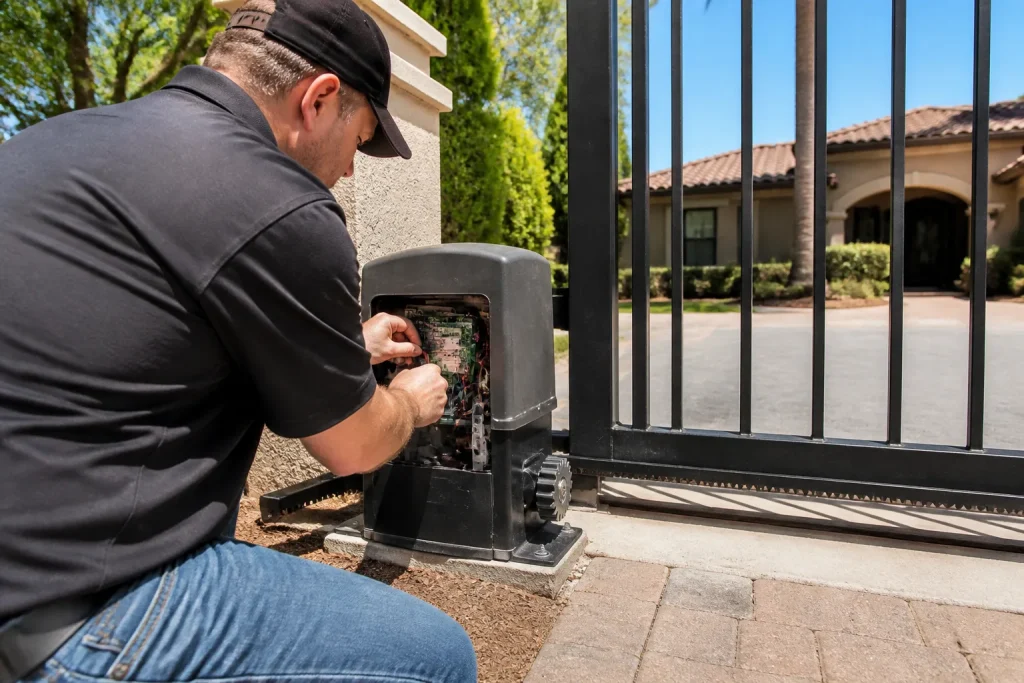
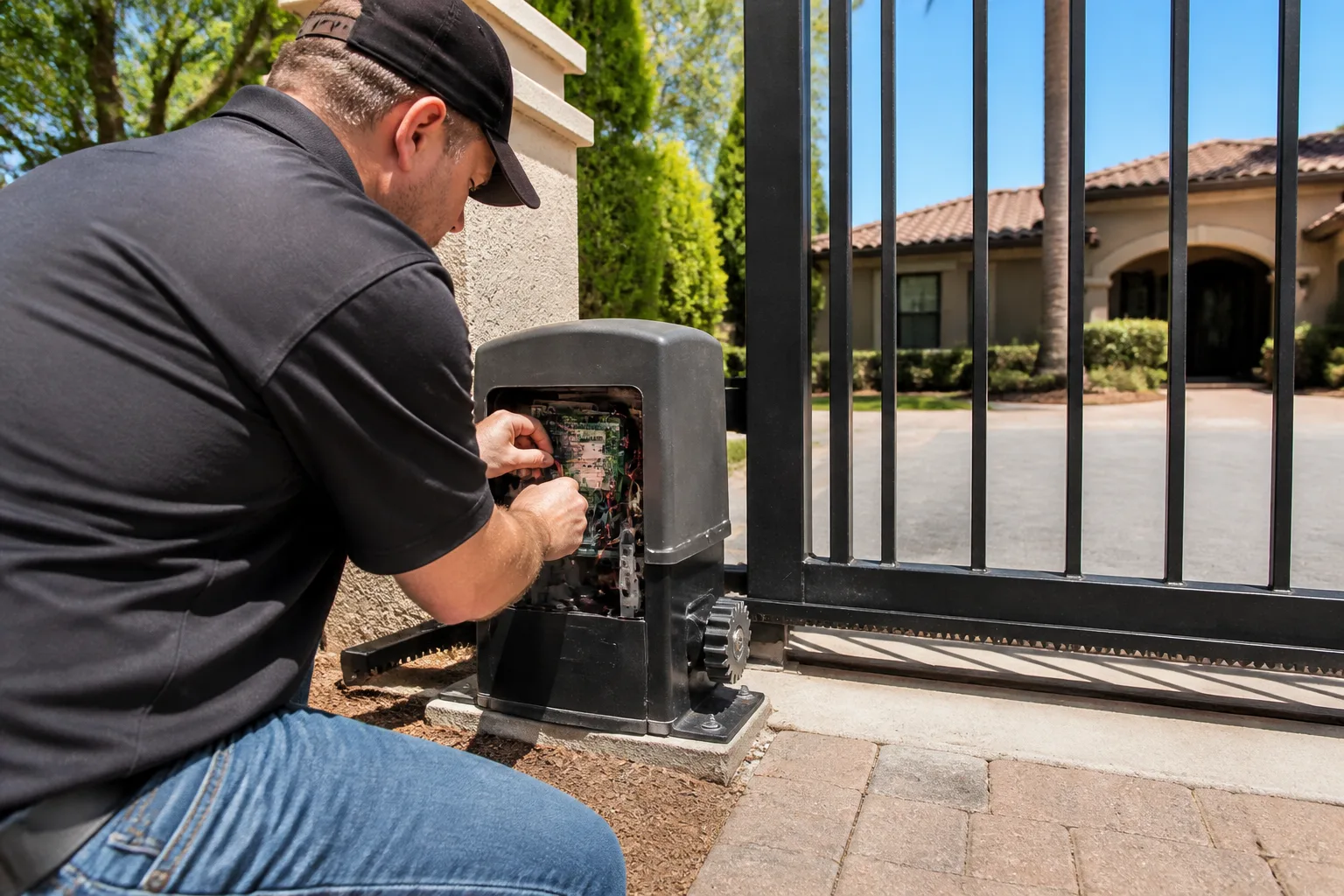
LiftMaster gate repair in Rialto usually comes down to one of three things: a failed control board, a worn limit switch, or a battery that’s quietly given up. Most Rialto homeowners we hear from don’t realize their LiftMaster operator is actually repairable, which means a lot of perfectly serviceable units get replaced instead of fixed. If you’d rather skip the diagnosis and get straight to a solution, call (866) 569-6584 for a free estimate.
Why LiftMaster’s LA400 and LA500 Series Show Up So Often in Rialto
LiftMaster’s LA400 (single swing) and LA500 (dual swing) operators are everywhere in Rialto. Drive through any neighborhood north of the 210 or down toward the 10 and you’ll see them on wrought-iron driveway gates, RV access gates, and side-yard pedestrian gates. They’re not failing because they’re badly built. They’re failing because there are simply a lot of them, and many have been in service for eight to twelve years. That’s a normal lifespan for a residential swing gate operator in the Inland Empire’s sun and heat.
The repair ecosystem for these units is mature. Boards, limit switches, gear assemblies, and battery backups are stocked by distributors, which means repair is rarely delayed by parts availability. In our experience, the bottleneck is almost always diagnosis, not procurement. A homeowner in Rialto will swap a battery when the real issue is a limit switch that no longer tells the board where the gate actually is. That kind of misdiagnosis turns a $200 repair into a $600 experiment.
The LA400 and LA500 are also straightforward to service in the field. The control board mounts to a single plate. The limit assembly is accessible under the cover. The battery slides out with two terminals. Compare that to a commercial LiftMaster CSW200 or IHSL series unit, and the service profile changes entirely, which is what we’ll get into next.
Residential vs. Commercial LiftMaster Units: Different Machines, Different Failure Profiles
LiftMaster builds residential swing gate operators for intermittent daily use, maybe ten to twenty cycles a day. Commercial operators, like the CSW200 or CAPXL series used at Rialto apartment complexes and industrial yards, are built for fifty to two hundred cycles daily. That difference in duty cycle changes how they fail and how they should be repaired.
A residential LA400 that chatters or stalls is typically dealing with a mechanical binding issue, a failing capacitor, or a board that’s lost its calibration. A commercial unit with the same symptom is more likely to have a worn gear reducer, a thermal overload tripping from continuous cycling, or a failing motor capacitor that’s been running hot for months. The fix looks different. You don’t put a residential-grade logic board in a commercial operator and expect it to hold up, even if the plugs fit.
For Rialto multi-family properties, duty cycle is the first thing we check when a LiftMaster gate starts misbehaving. If the gate serves forty units and everyone enters twice a day, that’s 160 cycles minimum. A residential operator won’t survive that for long. We’ve pulled commercial LiftMaster units from gated communities in Rialto where the board had been replaced three times by a generalist who kept swapping parts instead of addressing the fact that the operator was undersized for the traffic.
This is why electric gate repair in Rialto hinges on knowing which class of operator you’re actually dealing with before turning a single screw.
myQ Integration: When Connectivity Problems Masquerade as Mechanical Failures
Most newer LiftMaster gate operators with myQ built in will report their status to a phone app. That’s genuinely useful, but it also creates a new failure category that older operators never had: the connectivity issue that looks like a mechanical problem.
We’ve been called to Rialto homes where the homeowner swore the gate motor was dead because the app said “Offline.” What actually happened: the myQ Wi-Fi module lost its connection to the home router, and the gate was perfectly fine sitting there waiting for a command. The operator wasn’t broken. The network was.
Here’s how we separate the two in the field:
- Does the gate respond to the wired push button or keypad, but not the app? That’s a connectivity problem, not a mechanical or board issue.
- Does the gate make a humming sound but not move? That’s mechanical binding or a capacitor problem, not connectivity.
- Does the myQ hub show a solid green LED but the app still says offline? You’re likely looking at a Wi-Fi signal issue between the hub and the router, common in Rialto homes where the garage is far from the access point.
- Does the gate open halfway then reverse? That’s a limit or obstruction sensor issue, nothing to do with the app.
myQ is a diagnostic aid, not a diagnostic tool. It tells you what the board thinks is happening. It doesn’t tell you why. We’ve seen Rialto homeowners replace perfectly good operators because the app kept throwing an error, when the actual fix was a $20 Wi-Fi extender or a router firmware update.
Field-Serviceable vs. Factory-Return: What Can Actually Be Fixed On-Site in Rialto
LiftMaster gate operators break down into two categories for repair purposes: components we can replace or rebuild on-site, and components that must go back to the manufacturer or be replaced entirely.
Field-serviceable components include:
- Control boards – Swappable on-site. The LA400, LA500, and most commercial units use plug-in harnesses rather than soldered connections.
- Limit switches and cams – Mechanical adjustment or replacement takes under an hour on most models.
- Battery backups – Two-terminal swap. Takes five minutes once the cover is off.
- Gear assemblies and sprockets – Replaceable on residential units. On commercial units, we’re usually replacing the entire reducer rather than rebuilding it.
- Photo eyes and edge sensors – Universal replacements work across most LiftMaster models.
- Keypads and receivers – Straight swaps with reprogramming.
Factory-return or replace-only items are fewer, but they exist:
- Motor windings – If the motor itself is burned out on a residential unit, you’re replacing the operator. Rewinding a fractional-horsepower motor costs more than the new unit.
- Internal transformers – Sometimes replaceable on commercial boards, rarely on residential ones.
- Cracked housings – If the composite case is physically broken, water gets in, and no board replacement will fix that long-term.
For Rialto homeowners, the practical takeaway is this: most LiftMaster failures are repairable without replacing the entire operator. The exceptions are motor failure and physical housing damage. Everything else is a parts-and-labor job that typically runs less than half the cost of a new installation.
Checking LiftMaster Warranty Status Before You Pay for a Repair
This is the step most Rialto homeowners skip, and it costs them real money. LiftMaster warranties vary by model, but many residential operators carry a 5-year motor warranty and 1-year parts warranty from the date of purchase or installation. Commercial units differ based on the series and the installer’s status.
To check if your unit is still covered:
- Find the model number. It’s printed on a label inside the control box cover, usually starting with “LA” for residential swing operators or “CSW” / “IHSL” for commercial.
- Find the serial number. Same label. LiftMaster serial numbers are typically 14 to 16 digits.
- Check your original paperwork if you have it. The installation date matters, not just the manufacturing date.
- Call LiftMaster support with both numbers, or ask a gate professional to run the check for you.
If the unit is under warranty, the replacement part is free. You pay only for labor and, often, a diagnostic fee. If it’s out of warranty, the repair is all on you, and that’s where accurate diagnosis matters most because you don’t want to spend money on a guess.
One Rialto-specific note: heat kills batteries. If your LiftMaster battery backup is dead and the unit is just outside warranty, that’s normal. We see it on three to four-year-old installs all over the city. It’s a wear item, like brakes on a car, and it’s a quick fix.
Why LiftMaster Gates Need Different Diagnostic Tools Than LiftMaster Garage Doors
LiftMaster makes both gate operators and garage door openers, and the shared brand name confuses a lot of Rialto homeowners. The tools and diagnostic approaches for these two product lines are not interchangeable.
A LiftMaster garage door opener is a linear actuator with a travel limit and a safety reversal. A LiftMaster gate operator adds several layers that garage openers don’t have: edge sensors for entrapment protection, separate opening and closing limits, often a battery backup, frequently a vehicle detection loop, and sometimes a telephone entry or access control integration.
The diagnostic tools reflect that complexity. Gate operators require:
- Force profile evaluation – Gates must meet UL 325 entrapment standards, which means the operator’s force curve has to be measured and adjusted on-site. Garage openers don’t have the same requirement.
- Edge sensor testing – Photo eyes on a gate have to be tested for response time and alignment, not just presence.
- Loop detector function checks – Vehicle detection loops are common on Rialto driveway gates and must be verified as part of any repair.
- Battery load testing – Gate batteries need to hold voltage under load, not just show a full charge at rest.
We’ve had Rialto customers tell us a garage door tech looked at their LiftMaster gate and walked away. That’s the right call. The brands share a name, but the certification, training, and diagnostic equipment are different. If your gate isn’t working, call someone whose whole job is gates, not someone who installs openers on the side.
When to Call a Pro
You can check power, reset breakers, and verify your myQ app connection. But the moment you’re looking at an open control box with a multimeter in hand, you’re past DIY territory. Control boards carry live voltage. Gate operators store energy in capacitors that can discharge even with power removed. And UL 325 compliance isn’t optional, it’s a safety standard that protects anyone walking near your gate.
If you’re in Rialto and the problem is intermittent, affecting a commercial property, or accompanied by burning smells or arcing sounds, call a specialist. Gate repair in Rialto is what we do full-time, and we’d rather diagnose it correctly than have you chase parts around town.
Related services in Rialto: Gate Installation in Rialto and Gate Repair Rialto home.
The Bottom Line
LiftMaster makes good gate operators. The residential LA400 and LA500 are repairable, parts are available, and most failures come down to replaceable components like boards, limits, switches, and batteries. Commercial units are a different animal with duty-cycle-driven wear that demands a different diagnostic approach. myQ connectivity issues often mask as mechanical failures, so check the app carefully before assuming the worst. And always verify warranty status before paying for parts.
If you’re in Rialto and your LiftMaster gate is acting up, Gate Repair Rialto offers free estimates. We’ll diagnose it, quote the repair before any work begins, and get your gate operating again. Call (866) 569-6584.
Frequently Asked Questions
Most LiftMaster residential gate repairs in Rialto run between $180 and $450 depending on the component. Control board replacements typically land in the $250 – $400 range. Limit switches and battery replacements are usually $150 – $250. The exact price depends on which part failed and whether it’s a residential or commercial unit. Call (866) 569-6584 for a free estimate with the price quoted before work starts.
Yes. We keep the common LiftMaster LA400 and LA500 parts on our trucks, including boards, batteries, and limit assemblies. If the failure is in one of those components, we can usually complete the repair on the first visit. Less common parts may need to be sourced from a distributor, which adds a day or two. Call (866) 569-6584 and we’ll give you a realistic timeframe based on what your gate is doing.
Check the label inside the control box cover for the model and serial numbers, then call LiftMaster support or have a gate professional run the check. Residential operators often carry a 5-year motor warranty and 1-year parts warranty from the installation date. If the unit is under warranty, you pay only for labor and diagnosis, not the replacement part.
Yes. We service both residential and commercial LiftMaster gate operators, including the CSW200 and IHSL series used at Rialto apartment complexes, business parks, and industrial facilities. Commercial repairs focus on duty-cycle failures, gear reducer wear, and access control integration rather than the simpler residential failure modes. Call (866) 569-6584 to schedule a commercial service visit.
Written by the team at Gate Repair Rialto, serving Rialto since 2013.
Need Gate Repair Help?
Call Gate Repair Rialto - licensed & insured, here with fast help in Rialto.
(866) 569-6584